
If you've been researching water filters, you've probably come across the term PFAS, often called "forever chemicals." These synthetic compounds have been used in non-stick cookware, stain-resistant fabrics, firefighting foam, and hundreds of industrial applications for decades. Unfortunately, they've also become one of the most widespread drinking water contaminants in the United States.
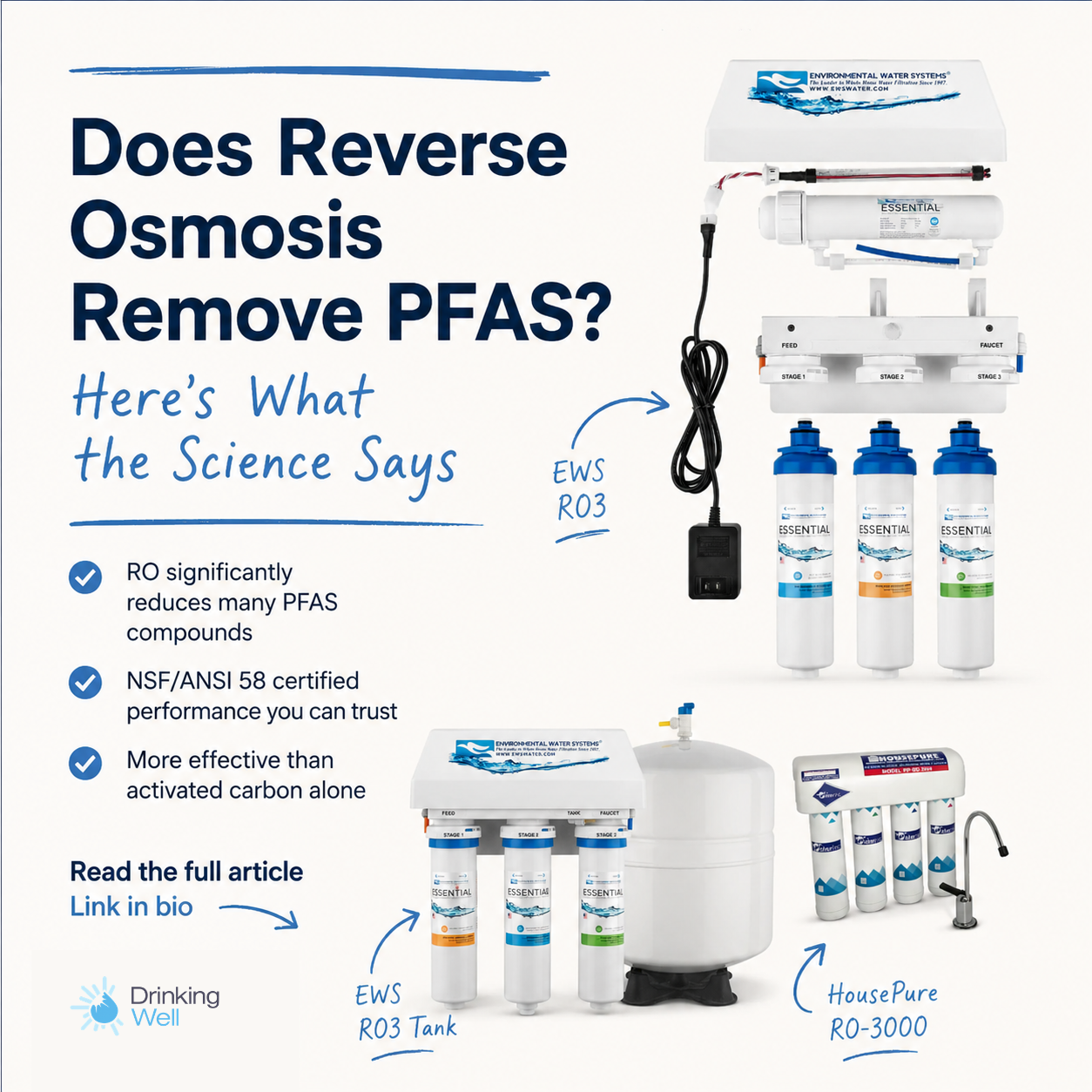
The good news? Reverse osmosis (RO) is one of the most effective home water treatment technologies available for reducing PFAS. In fact, independent research and water treatment experts consistently identify reverse osmosis as one of the best point-of-use technologies for reducing many PFAS compounds in drinking water.
What Are PFAS?
PFAS (Per- and Polyfluoroalkyl Substances) are a large family of man-made chemicals designed to resist heat, grease, oil, and water. Because they break down very slowly, they have earned the nickname "forever chemicals."
Some of the most common PFAS compounds include:
-
PFOA (Perfluorooctanoic Acid)
-
PFOS (Perfluorooctane Sulfonate)
-
PFHxS
-
PFNA
-
GenX chemicals
PFAS have been detected in drinking water supplies throughout the United States and around the world.
Does Reverse Osmosis Remove PFAS?
Yes.
A properly designed reverse osmosis system can significantly reduce many PFAS compounds found in drinking water.
Reverse osmosis works by forcing water through a semi-permeable membrane with microscopic pores that reject many dissolved contaminants, including many PFAS molecules. Numerous studies have demonstrated that reverse osmosis is among the most effective residential filtration technologies currently available for PFAS reduction.
Which PFAS Does Reverse Osmosis Remove?
While performance varies depending on the specific membrane, water quality, and system design, reverse osmosis has been shown to reduce many common PFAS compounds, including:
-
PFOA
-
PFOS
-
PFHxS
-
PFNA
-
Numerous additional long-chain PFAS compounds
It's important to remember that PFAS refers to thousands of different chemicals, and no filtration technology should claim to remove every PFAS compound under every water condition unless that reduction has been independently verified.
Reverse Osmosis vs. Activated Carbon
Both reverse osmosis and activated carbon are excellent filtration technologies—but they serve different purposes.
| Reverse Osmosis | Activated Carbon |
|---|---|
| Removes many dissolved contaminants | Excellent for chlorine, taste, and odor |
| Reduces fluoride, nitrates, many heavy metals, TDS, and many PFAS compounds | Can reduce many PFAS compounds when properly designed and certified |
| Produces highly purified drinking water | Leaves naturally occurring minerals in the water |
| Uses a semi-permeable membrane | Uses adsorption media |
The best systems often combine both technologies.
Many premium reverse osmosis systems include multiple carbon filtration stages before and after the RO membrane. The carbon filters help remove chlorine and chloramines before they reach the membrane, extending membrane life while improving overall water quality.
What Certifications Should You Look For?
When comparing water filters, don't rely solely on marketing claims.
Instead, look for systems that have been independently tested to recognized standards.
For reverse osmosis systems, NSF/ANSI Standard 58 is the primary certification covering reverse osmosis performance. Carbon filtration systems may also carry contaminant reduction claims under NSF/ANSI Standard 53, depending on the contaminants being tested.
Independent certification helps verify that a system performs as advertised.
Our Recommended Reverse Osmosis Systems
If PFAS reduction is one of your primary goals, choosing a high-quality reverse osmosis system from a trusted manufacturer is one of the best investments you can make.
HousePure Reverse Osmosis System
The HousePure Reverse Osmosis System (WI-HP-RO-3000) is certified to NSF Standards 42, 53, and 58 and is designed to reduce a wide range of contaminants while producing clean, great-tasting drinking water.
Learn more:
https://www.drinkingwellco.com/products/water-inc-wi-hp-ro-3000
EWS Essential RO3 Advanced 3-Stage Reverse Osmosis
The Environmental Water Systems Essential RO3 combines premium carbon filtration with a high-performance reverse osmosis membrane to reduce many dissolved contaminants while improving taste and odor.
View Product:
https://www.drinkingwellco.com/products/ro3-system
EWS Essential RO3-UV Reverse Osmosis
For homeowners looking for additional protection, the EWS Essential RO3-UV combines the proven performance of the RO3 with ultraviolet disinfection for an extra layer of water treatment.
View Product:
https://www.drinkingwellco.com/products/ro3-uv
Final Thoughts
If you're concerned about PFAS in your drinking water, reverse osmosis remains one of the most effective residential treatment technologies available today.
While no filtration system should promise to remove every PFAS compound under every water condition, a properly designed and maintained reverse osmosis system can significantly reduce many of the PFAS compounds commonly found in drinking water.
If you're unsure which reverse osmosis system is right for your home, our team at DrinkingWellCo is happy to help you compare options based on your water source, contaminants of concern, and filtration goals.


