
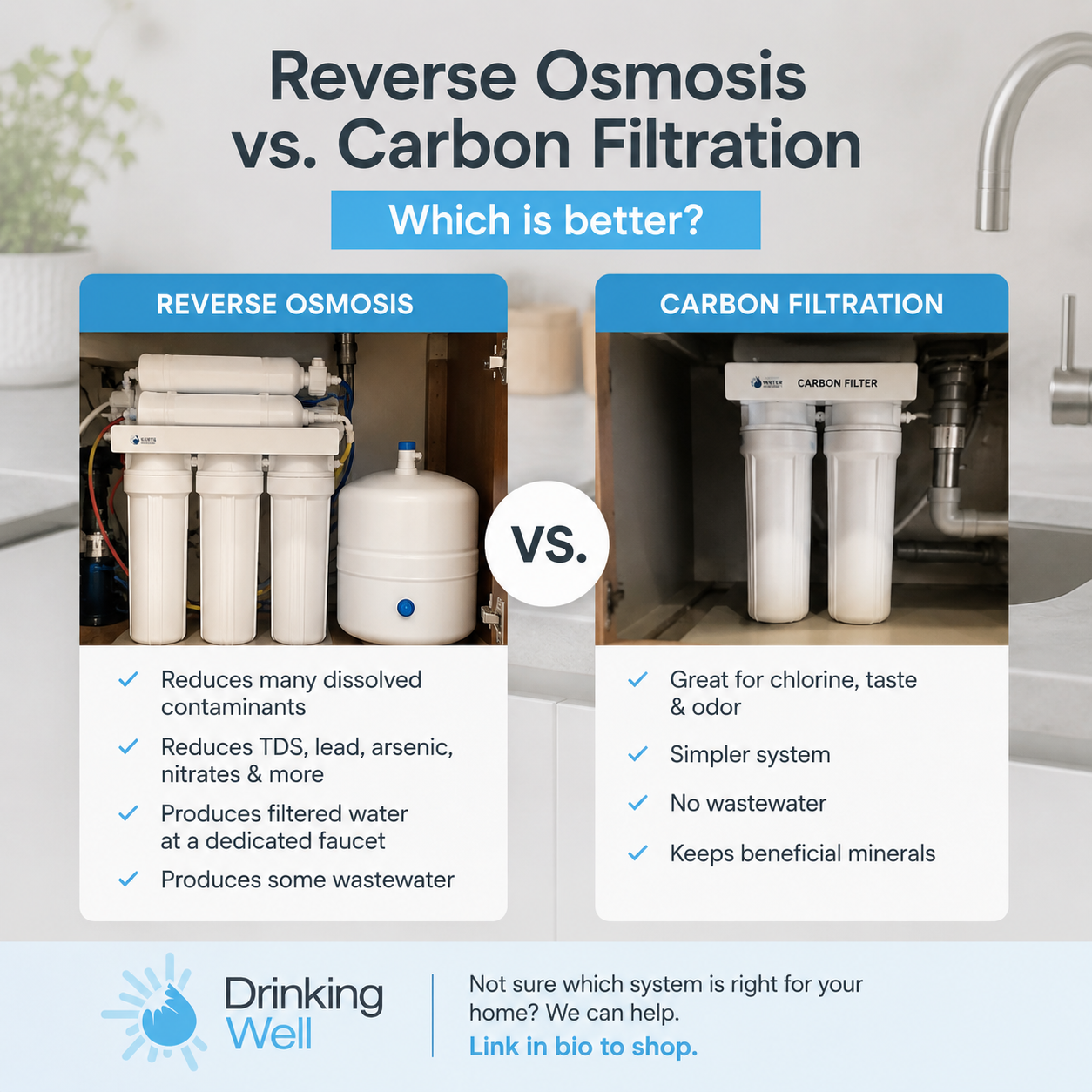
Reverse Osmosis vs. Carbon Filtration: Which Is Better?
Reverse osmosis and carbon filtration are two of the most popular ways to improve drinking water quality. Both are effective, but they work differently and are designed to address different water-quality concerns.
So, which one is better?
It depends on what's in your water and what you want to remove.
What Is Carbon Filtration?
Carbon filtration uses activated carbon to capture certain contaminants as water passes through the filter.
Carbon filters are particularly effective for improving chlorine taste and odor and can reduce additional contaminants depending on the specific filter and its certifications.
Carbon filtration is commonly found in under-sink systems, refrigerator filters, whole-house systems and even reverse osmosis systems.
One major advantage is simplicity. Carbon systems generally don't produce wastewater and typically require less equipment than reverse osmosis.
What Is Reverse Osmosis?
Reverse osmosis (RO) forces water through a semipermeable membrane designed to reduce many dissolved substances.
Depending on the system and its certifications, RO can reduce contaminants such as:
-
Total dissolved solids (TDS)
-
Lead
-
Arsenic
-
Fluoride
-
Nitrate and nitrite
-
Sodium
-
Chromium
Many RO systems also incorporate carbon filtration before or after the RO membrane, so the two technologies are often used together rather than separately.
Reverse Osmosis vs. Carbon Filtration
| Feature | Carbon Filtration | Reverse Osmosis |
|---|---|---|
| Chlorine, taste & odor | Excellent | Excellent when carbon stages are included |
| TDS reduction | Minimal | Excellent |
| Dissolved contaminants | Limited | Broader reduction |
| Naturally occurring minerals | Generally retained | Reduced |
| Wastewater | Typically none | Produces reject water |
| Installation | Simpler | More involved |
| Maintenance | Generally simpler | Multiple filters + membrane |
Which One Should You Choose?
Carbon filtration may be better if:
-
Your primary concern is chlorine, taste or odor
-
You want to retain naturally occurring minerals
-
You don't need significant TDS reduction
-
You want a simpler under-sink system
-
You don't want RO wastewater
Reverse osmosis may be better if:
-
You want broader contaminant reduction
-
You want to reduce TDS
-
You're concerned about certain dissolved contaminants
-
You don't mind additional maintenance
-
You specifically want RO-treated drinking water
If you're concerned about a specific contaminant, always review the manufacturer's performance data and certifications before choosing a system.
Recommended Water Filtration Systems
DrinkingWellCo carries both reverse osmosis and advanced non-RO filtration systems. Here are a few of our favorites.
EWS Essential RO3
The EWS Essential RO3 combines reverse osmosis with advanced carbon filtration, giving homeowners the benefits of both technologies in one under-sink system.
Best for: Broader contaminant and TDS reduction.
Body Glove BG-3000
The Body Glove BG-3000 is a compact under-sink filtration system designed for everyday drinking and cooking water.
It's a strong middle-ground option for households that want advanced filtration without moving to reverse osmosis.
Best for: Everyday under-sink drinking-water filtration.
Body Glove BG-6000FF
The Body Glove BG-6000FF is designed for higher-flow applications and filters water directly through the main kitchen faucet, eliminating the need for a separate drinking-water faucet.
The system has a rated filter life of approximately 6,000 gallons or one year.
Best for: Busy kitchens that want filtered water without sacrificing faucet flow.
Body Glove BG-12000
The Body Glove BG-12000 is Body Glove's premium under-sink option, designed for customers looking for more comprehensive contaminant reduction.
Its filtration includes reduction claims for chlorine taste and odor, lead, chloramines, VOCs, cysts and other contaminants.
Best for: Premium non-RO under-sink filtration.
Waterstone Under-Sink Filtration
For homeowners building a premium kitchen, Waterstone filtration systems pair naturally with Waterstone filtration faucets and provide an alternative to reverse osmosis.
Best for: Premium kitchen installations.
Shop Waterstone Filtration Systems
The Bottom Line
Neither reverse osmosis nor carbon filtration is universally better.
If you're primarily looking to improve taste, odor and chlorine while keeping your system simple, a quality carbon-based system may be the better choice.
If you're looking for broader reduction of dissolved contaminants and TDS, reverse osmosis generally offers an advantage.
And you don't necessarily have to choose one or the other. Many high-quality RO systems combine carbon filtration with an RO membrane to take advantage of both technologies.
The best place to start is with your water quality and the contaminants you actually want to address.


